
You land in Dubai with three days and a list that is already too long. Burj Khalifa, the Mall, the Fountain, the souks, the Palm and the desert, and somewhere in there you are supposed to enjoy yourself instead of rushing from one queue to the next. This guide gives you the famous places in the order that makes sense, grouped by area, with a simple day plan at the end. And here is the question most guides never answer: which places are worth your evening, and which are better in the morning?
What to do in Dubai starts with three icons in one place: Burj Khalifa, Dubai Mall and the Dubai Fountain. This guide covers the Dubai attractions that matter most on a first trip, in the order that makes sense. From there, the city splits into two halves worth seeing, the modern skyline of Downtown, the Marina and Palm Jumeirah, and the old city of Al Fahidi, the souks and Dubai Creek. If you have ever landed somewhere famous and felt quietly worried that you would see the postcards but miss the place itself, that worry is exactly what this guide is for.
The icons first: Burj Khalifa, Dubai Mall and the Fountain
Burj Khalifa is the tallest building in the world at 828 metres, and it is the one place almost every visitor sees first. Book an observation deck ticket online before you go, especially in the winter season from November to March, when the evening slots sell out. Go for a late afternoon slot if you can. You get the daylight view, the sunset, and then the city lighting up below you in a single visit.
Dubai Mall sits at its foot, with more than 1,200 stores, the Dubai Aquarium and an ice rink, so it works as a full day on its own. Do not try to see the whole Mall. Pick one thing inside it and then get back outside, because the Mall will happily eat your whole day if you let it.
The Dubai Fountain sits on Burj Lake between the two, stretches 275 metres across the water and shoots water up to 150 metres high, and its evening shows run every 30 minutes from 6pm to 11pm. The shows are free to watch from the Waterfront Promenade, the Souk Al Bahar bridge or Burj Park, so plan to be in Downtown for sunset and stay for the lights. Here is the real example that proves the point: the Fountain is 275 metres long, it throws water 150 metres into the air, and it costs nothing to watch. Watch two or three shows, because each one plays a different song.
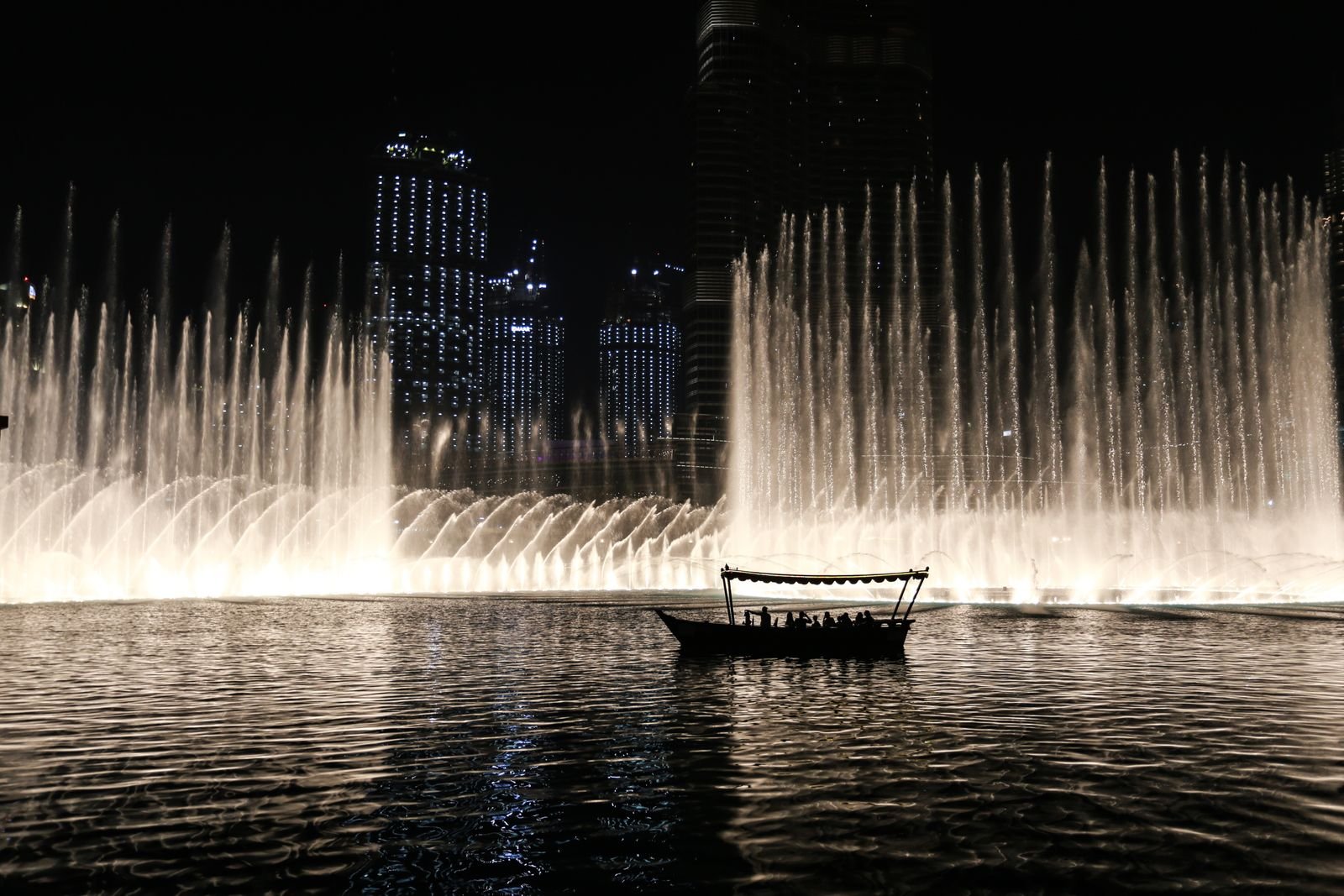
Your decision here is simple. Book the tower, browse the Mall with a limit, and be outside by sunset for the Fountain. But the towers are only half the city, and the older half is where Dubai starts to feel like a real place rather than a postcard.
Old Dubai: Al Fahidi, the souks and the Creek
Old Dubai is where you see what the city was before the towers. Al Fahidi Historical Neighbourhood, also known as Al Bastakiya, is a quiet area of wind tower houses, narrow lanes and courtyards from the early 1900s, and it is free to wander. Go in the morning, when the lanes are cool and quiet, and give yourself an hour with no plan at all.
From there, cross Dubai Creek on a traditional abra boat, then walk the Gold Souk and the Spice Souk in Deira, where shop lights, bargaining and the smell of spices fill the lanes into the evening. The souks are free to browse, and the cooler evening air makes them far more comfortable than midday. In the Gold Souk, look first and bargain second. Al Seef, the creekside district beside Al Fahidi, is also worth an evening walk, with lit walkways and places to eat by the water.
Your decision here is about timing. Old Dubai belongs to the morning and the evening, never to the middle of the day. Do Al Fahidi in the morning and the souks after sunset, and you will enjoy both. Do them at noon in summer and you will remember only the heat. And once you have seen the old city, the coast is waiting, and it is the part of Dubai that photographs best.
Palm Jumeirah and the coast
Palm Jumeirah is the palm shaped island visible from space, and it is best seen from the water or from a high viewpoint, because at street level it feels like a normal beachfront road. Do not judge it from a taxi window. See it from a boat, from the Monorail, or from a viewpoint, and the shape suddenly makes sense.
The Beach at JBR, at the foot of the Palm, is the liveliest public beach in the city, with restaurants, shops and Ain Dubai, the giant observation wheel on Bluewaters Island, across the water. Check Ain Dubai’s current operating status before you go, because its opening status has changed several times. For a quieter coast, head to Kite Beach for water sports, or to Sunset Beach for the classic Burj Al Arab photograph. Plan beach days for November to April, when the sea is pleasant and the heat is low.
Your decision here is which beach matches your mood. JBR if you want energy and food within steps of the sand. Kite Beach if you want to move. Sunset Beach if you want the photograph. Pick one beach per day, because beach hopping wastes the afternoon in traffic. And after the coast, the city has two stops that show you its culture in a single afternoon.
Culture and family: Dubai Frame, Museum of the Future and Global Village
Dubai Frame is a giant picture frame that shows old Dubai on one side and new Dubai on the other, and it is one of the quickest culture stops in the city. It takes about an hour, and it gives you the whole story of the city in one frame, which is why it works so well on a first trip.
The Museum of the Future, with its gleaming steel calligraphy shell on Sheikh Zayed Road, is the most photographed new building in Dubai, and it is worth booking ahead because tickets sell out in peak season. The building itself is the attraction as much as what is inside, so walk around the outside and take the photograph before you go in.

Global Village is the evening only cultural park that runs from October to May, and Season 31 opened on 14 October 2026 and runs to May 2027, with pavilions, food, rides and nightly fireworks. Dubai Miracle Garden, with more than 150 million flowers across 72,000 square metres, is the world’s largest natural flower garden, and it is best in the cooler months. For Global Village planning, read Global Village Season 31 Tickets.
Your decision here is to pair these stops with the right day. Dubai Frame fits a morning. The Museum of the Future fits a morning too, if you book early. Global Village is an evening, and only in season. Put the Frame and the Museum on different days, because both deserve a slow hour. But no Dubai trip is complete without leaving the city behind for one evening, and that evening belongs to the desert.
The desert: half a day that feels like another country
A desert safari takes an afternoon and an evening, and it is best from November to March. A typical trip leaves the city in the afternoon, drives out to the dunes, and ends with dinner and a show at a desert camp. The dune drive, the camel ride and the sunset over open sand are the parts people remember. The camp dinner and show are pleasant, but the dunes are the reason to go.
Book with a licensed operator and read what is included before you pay. Some trips include sandboarding and a short camel ride, others charge extra on the day. If you get carsick, say so before the dune drive, because the driver can take a gentler route. Wear closed shoes for the sand and bring a light layer, because desert nights cool down fast.

Your decision here is simple. Add the desert only if you have a spare half day, because it takes an afternoon and an evening and it sits outside the city. If you have only three days, keep the desert for day three or four, never for day one, because day one belongs to Downtown. And once you know what to see, the next question is how to fit it all together without losing hours to traffic.
How to plan your days without wasting them
Dubai is a driving city, and its districts are far apart. The mistake most visitors make is not picking the wrong places. It is picking the right places in the wrong order. Group your days by area, not by attraction. Do Downtown, the Mall and the Fountain together in one day, Old Dubai and the Creek together in half a day, and the Marina, JBR and Palm Jumeirah together in one day, because Dubai traffic eats hours when you jump between districts.
Your decision here is to plan by area and to leave gaps. A day with three things and time to breathe beats a day with six things and no time to enjoy any of them. Now, what does all of this cost? Less than most people fear, if you know where the free things are.
What a Dubai trip costs, in general terms
Many of the best things in Dubai cost nothing. The Fountain shows, the beaches, the Marina Walk, Al Fahidi, the souks and Burj Park are all free. The abra across Dubai Creek costs a small fare, so check the current fare on the RTA page before you go. That means a full day can cost you nothing but food and transport if you plan it that way.
Your decision here is to spend on one big view and one big experience, and to let the free things carry the rest of the day. The Fountain at night costs nothing and beats most paid shows. But even a well planned trip has traps, and the traps are the same for almost every first time visitor.
Mistakes first time visitors make
The first mistake is trying to see everything in two days. Dubai rewards a slower pace, and three full days cover the famous places properly. The second mistake is visiting the beach or the souks at midday in summer. Go early, go late, and spend the middle of the day indoors. The third mistake is skipping Old Dubai entirely. Visitors who only see the towers go home with photographs and no sense of the city.
The fourth mistake is not booking ahead. Burj Khalifa evening slots, Museum of the Future tickets and Global Village weekends all sell out in the winter season. The fifth mistake is trusting old guides. Ain Dubai has closed and reopened several times, so check the current status before you plan around it. The sixth mistake is packing only summer clothes. Malls, the Metro and restaurants run cold with air conditioning, so carry a light layer even in summer, and a light jacket for winter evenings.
Your decision here is to avoid these six mistakes and the trip almost plans itself. Now, with the planning done and the traps avoided, here is the short list that ties it all together.
Dubai landmarks you should not miss
These are the Dubai landmarks that define a first trip, in rough order of importance. Burj Khalifa for the view, Dubai Mall and the Fountain for the evening, Al Fahidi and the souks for the old city, Palm Jumeirah and JBR for the coast, Dubai Frame for the two Dubais in one picture, and the Museum of the Future for the new city. Add the desert only if you have a spare half day, because it takes an afternoon and an evening, and it is best from November to March. If you only have one day, do Downtown in the morning, Old Dubai in the afternoon, and the Fountain and a Marina walk in the evening.
That short list is the whole trip in one paragraph, and it is the list to keep on your phone. But a list is not a plan, so here is the plan itself, day by day.
A simple three day plan
Day one is Downtown: Burj Khalifa in the late afternoon, Dubai Mall after, and the Fountain shows after dark. Day two is Old Dubai: Al Fahidi in the morning, the abra across the Creek, the Gold Souk and Spice Souk in the afternoon, and Al Seef for dinner. Day three is the coast: the Marina Walk and Pier 7 in the morning, JBR beach in the afternoon, and the Palm at sunset. Add Global Village as an evening on any of those days while it is in season, and add the Museum of the Future or Dubai Frame to day one or day two. For a sporty trip, read Dubai Run 2026, which closes Sheikh Zayed Road to traffic once a year and is one of the best ways to see the city on foot, or plan around Dubai Marathon 2027 in January.
If you have a fourth day, spend it in the desert, or take a second beach day at Kite Beach or Palm West Beach. If you have only two days, cut the coast day, not the Old Dubai half day, because the old city is what makes the trip feel complete. Three days, grouped by area, booked ahead, with the evenings free for the Fountain and the Marina. That is what to do in Dubai, and it is enough.