
You have seen the photos a hundred times, white domes against a blue sky, a courtyard that looks like polished marble, minarets that catch the light at sunset. Then you arrive, and the first question is not about the beauty, it is about the rules: do you need a ticket, what can you wear, and will they turn you away at the door? This guide answers all three before you leave your hotel, and the one detail that catches most visitors is the one you would never guess.
Sheikh Zayed Grand Mosque in Abu Dhabi is open to visitors Saturday to Thursday 09:00 to 21:00, with last entry at 20:30, and on Friday 09:00 to 12:00 and 14:30 to 21:00. Entry is no longer free for tourists: since September 2026, visitors from outside the UAE pay AED 10, Emirates ID holders pay AED 5, and every visitor must book a pass online on szgmc.gov.ae before they go. Worshippers enter free without a pass. Book your pass, dress to the code, and allow 1.5 to 2 hours for your Sheikh Zayed Grand Mosque visit. If you have ever queued at a famous place only to learn at the gate that you needed a booking you did not have, that worry is exactly what this guide removes.
Tickets and booking
Book first, because you cannot enter without a pass. Every visitor needs a pass booked online on the official Sheikh Zayed Grand Mosque Centre website, szgmc.gov.ae, and you can book up to about a month ahead. The pass is issued online after you confirm with a one time password sent to your email. Admission fees apply as follows: visitors from outside the UAE AED 10, Emirates ID holders AED 5, and visitors through tour operators AED 8 per person, according to the official FAQ on szgmc.gov.ae. Worshippers may enter directly free of charge without an entry ticket. Visitors aged 60 and over also enter free. Some news reports add children under 3 and People of Determination to the free list, so confirm when you book. Private tours should be booked at least 24 hours ahead.
Here is the real example that shows why the booking matters more than the price. The entry fee is only AED 10 for a tourist, which is less than a coffee in Dubai, yet a visitor without a booked pass cannot enter at all, whatever they are willing to pay at the gate. The pass costs almost nothing, but forgetting it costs the whole visit. Book the pass the moment you fix your travel date, because you can book up to about a month ahead, and keep the confirmation on your phone. Check the free list when you book, because the official FAQ confirms free entry for worshippers and for visitors aged 60 and over, while the free entry for children under 3 and People of Determination appears only in news reports, so confirm it when you book rather than assuming it. But the pass is only the first gate, because the dress code is the one that turns people away.
Opening hours and Friday closures
Visiting hours are Saturday to Thursday 09:00 to 21:00, with last entry at 20:30. On Friday, visiting hours are 09:00 to 12:00 and 14:30 to 21:00, with last entries at 11:30 and 20:30, because the mosque closes to visitors from 12:00 to 14:30 for the midday prayer. The official FAQ lists the end of visiting as 8:30 PM, which matches the last entry time. On a Friday, the afternoon is easier than the morning, so plan a morning visit before 11:30 or an afternoon one after 14:30. Hours can change during Ramadan, Islamic holidays and special events, so check the official site the day before you travel.
The Friday gap is the trap most visitors fall into. A Friday morning visit must end by 11:30, because the mosque closes to visitors from 12:00 to 14:30 for the midday prayer, and a visitor who arrives at 12:15 will wait two hours outside. Plan a morning visit that finishes before 11:30, or arrive after 14:30 for the afternoon session, which runs to 21:00 with last entry at 20:30. On other days the rule is simpler: arrive any time from 09:00, but enter by 20:30, because the official FAQ lists the end of visiting as 8:30 PM. Check the official site the day before you travel, because hours can change during Ramadan, Islamic holidays and special events. And Ramadan changes the hours completely, so read the Ramadan times before you plan a visit in that month.
Ramadan visiting hours
During Ramadan the hours change. In the first 20 days the mosque is open to visitors Monday to Sunday 09:00 to 18:00 and 21:30 to 01:00, and on Friday 14:30 to 18:00 and 21:30 to 01:00. In the last 10 days, it is open Monday to Sunday 09:00 to 18:00, and Friday 14:30 to 18:00. Ramadan moves each year with the lunar calendar, and in 2027 it is expected to start around 8 February, depending on the sighting of the moon.
Ramadan splits the day in two, and the night session is the one visitors remember. In the first 20 days, the mosque opens to visitors in the morning and afternoon, then closes, then opens again from 21:30 to 01:00, so you can see the mosque lit up after dark in a way the daytime visit never shows. In the last 10 days, the night session closes, and visiting ends at 18:00. The start of Ramadan in 2027 is expected around 8 February, but the exact date depends on the sighting of the moon, so confirm it before you book travel. For the Ramadan and Eid dates, read UAE Public Holidays 2027. But whatever month you visit, the dress code does not change, and it is the strictest rule in this guide.
Dress code: what to wear
The dress code is strict, and visitors who do not meet it will not be admitted. Women must wear loose clothing that is not transparent, covering the arms and legs, down to the ankles, with sleeves to the wrists, and a headscarf covering the hair. Men must wear long trousers and a shirt with at least short sleeves, with no shorts or sleeveless tops. The mosque does not lend abayas or kandouras at the entrance, whatever older blogs say. If your clothes do not meet the code, you can buy an abaya at Souq Al Jami next to the mosque for about AED 45. It is simpler to bring a scarf and long clothes with you. Children are welcome but must stay with their parents at all times.
Tip: Dress correctly before you leave your hotel, and carry a headscarf even if you think you will not need one. The mosque does not lend abayas at the entrance, so the wrong outfit means a trip to the shops or no entry at all.
The dress code is the one rule that no ticket can fix. A booked pass gets you to the gate, but shorts, a sleeveless top, or uncovered hair will stop you there, and the mosque does not lend abayas or kandouras at the entrance, whatever older blogs say. The fallback is Souq Al Jami next to the mosque, where you can buy an abaya for about AED 45, but that means a shopping trip before your visit, and time lost from the 1.5 to 2 hours you planned. Dress correctly before you leave your hotel, wear loose clothing to the ankles with sleeves to the wrists, carry a headscarf, and keep children with you at all times. Once you are dressed right, the visit itself is simple, because everything starts in one place.

How the visit works
Everything starts at the Visitor Centre, so plan the visit in this order. Book the pass on szgmc.gov.ae, arrive at the Visitor Centre beside the mosque, pass the security check, then follow the designated visitor route across the courtyard and along the colonnades to the main prayer hall. Metal items, weapons and sharp objects are not allowed and are taken at the check, and the official list of banned items also includes fireworks, electronic cigarettes, dolls, masks and flags, so travel light. Inside the grounds, smoking is not allowed, and you cannot bring food; only water is permitted. Strollers, and electric carts for older visitors and people with disabilities, are available on request from the security staff. Visitors with disabilities get priority service. Allow 1.5 to 2 hours for the whole visit, including time for photos.
Travel light and the security check takes minutes. Metal items, weapons and sharp objects are taken at the check, and the banned list also includes fireworks, electronic cigarettes, dolls, masks and flags, so leave them at the hotel. Inside the grounds, smoking is not allowed, and you cannot bring food, only water is permitted. If you need a stroller or an electric cart, ask the security staff, because strollers and electric carts for older visitors and people with disabilities are available on request, and visitors with disabilities get priority service. Follow the designated route across the courtyard and along the colonnades to the main prayer hall, and allow 1.5 to 2 hours for the whole visit, including time for photos. The route is the visit, and the free tour is the best way to understand what you are walking through.
Free tours and paid extras
Free cultural tours run every day in English and Arabic, starting from the east side of the mosque, and the official FAQ gives their length as 45 to 60 minutes. Start times are not published, so ask at the entrance. A separate paid tour of the main prayer hall costs AED 30. Two more paid experiences were reported in September 2026: the Light and Peace Museum, with five themed sections and more than 65 rare objects, costs AED 25 and is open 09:00 to 22:00 with last entry at 21:30, and Diya, a 360 degree show of about 8 minutes, costs AED 25, with a combined ticket for both at AED 40. Sura Night Tours run daily from 9:00 PM to 9:00 AM, according to the official FAQ.
Take the free tour first, because it costs nothing and lasts 45 to 60 minutes, and it turns a beautiful building into a story you will remember. The tours run every day in English and Arabic from the east side of the mosque, but the start times are not published, so ask at the entrance when you arrive. After the free tour, decide on the paid extras: the main prayer hall tour at AED 30, the Light and Peace Museum at AED 25 with its five themed sections and more than 65 rare objects, and Diya, a 360 degree show of about 8 minutes, also at AED 25, with a combined ticket for both at AED 40. Sura Night Tours run daily from 9:00 PM to 9:00 AM, according to the official FAQ, so ask about them if you want the mosque after dark. But the building itself needs no tour to impress, because the numbers alone tell the story.
What to see inside
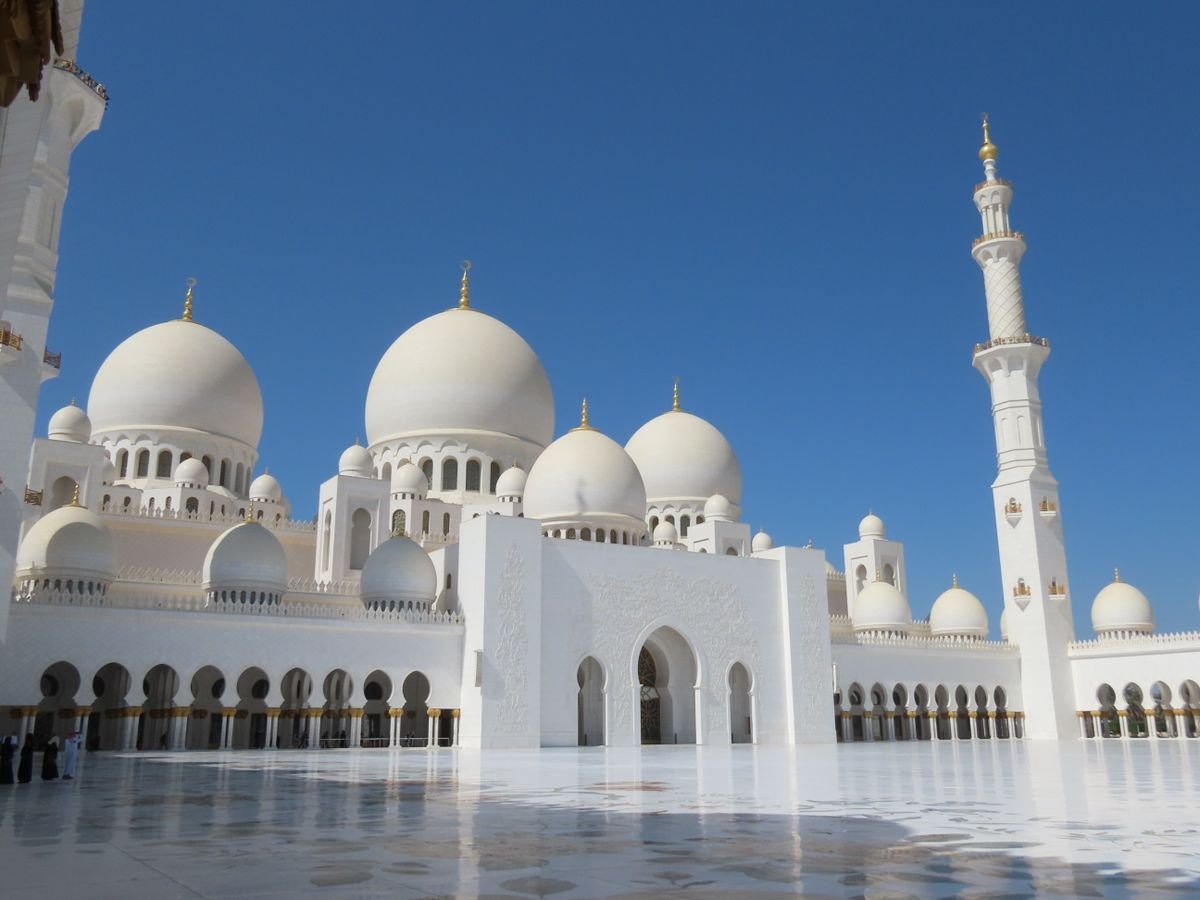
The Grand Mosque was built between 1994 and 2007 and opened in December 2007. The complex measures 290 by 420 metres, has 82 domes and four minarets about 104 metres high, and holds more than 40,000 worshippers. The courtyard covers 17,400 square metres and holds up to 31,000 worshippers when full, and its floor is a floral inlay of more than 9 million mosaic pieces in 3,825 panels, which the mosque own site says may be the largest marble mosaic in the world. The main prayer hall carpet covers more than 5,000 square metres. Seven chandeliers hang in the mosque, and the largest is about 10 metres across and set with Swarovski crystals. Sheikh Zayed bin Sultan Al Nahyan, the founding president of the UAE, who died in 2004, is buried on the grounds.
Stand in the courtyard and look down before you look up. The floor is a floral inlay of more than 9 million mosaic pieces in 3,825 panels, which the mosque own site says may be the largest marble mosaic in the world, and the courtyard alone covers 17,400 square metres and holds up to 31,000 worshippers when full. Then look up at the 82 domes and the four minarets, about 104 metres high, across a complex that measures 290 by 420 metres and holds more than 40,000 worshippers. Inside, the main prayer hall carpet covers more than 5,000 square metres, and seven chandeliers hang above it, the largest about 10 metres across and set with Swarovski crystals. The mosque was built between 1994 and 2007 and opened in December 2007, and Sheikh Zayed bin Sultan Al Nahyan, the founding president of the UAE, who died in 2004, is buried on the grounds. That history is why the visit feels different from any other landmark, and why the last decision is when to go.

Getting there and photography
From Abu Dhabi city, a taxi from downtown is the simplest option. If you prefer public transport, check current city bus routes on the Abu Dhabi Mobility website. From Dubai, intercity buses E100 and E101 run from Dubai to Abu Dhabi Central Bus Station for AED 25, and from there you take a city bus or a taxi to the mosque. Driving visitors use the south car parks, which are signposted, and there is a taxi area at the mosque during opening hours. Photography is allowed only at designated photo stops along the route. Personal photos with a phone or an ordinary camera are fine, but commercial and professional photography needs a permit, and the centre can confiscate equipment used against the rules. The best known views are the courtyard floor, the long reflecting pools at sunset, and the exterior lighting after dark, which follows the phases of the moon. The best time to arrive is about an hour before sunset, so you see the mosque in daylight and illuminated after dark. October to March is the most comfortable season, because from May to September temperatures can reach 44 degrees and much of the visit is outdoors.
Arrive about an hour before sunset and you get two visits in one. You see the white marble and the courtyard in daylight, then the exterior lighting comes on after dark, following the phases of the moon, and the long reflecting pools catch the light at sunset. Photography is allowed only at designated photo stops along the route, so take your photos there, because personal photos with a phone or an ordinary camera are fine, while commercial and professional photography needs a permit and the centre can confiscate equipment used against the rules. From Dubai, take intercity bus E100 or E101 to Abu Dhabi Central Bus Station for AED 25, then a city bus or a taxi to the mosque. From Abu Dhabi city, a taxi from downtown is the simplest option, and driving visitors use the signposted south car parks, with a taxi area at the mosque during opening hours. October to March is the most comfortable season, because from May to September temperatures can reach 44 degrees and much of the visit is outdoors. For the official prayer times before your visit, read How to Check Prayer Times in Dubai and Abu Dhabi, and for the citywide celebrations in the same season, read UAE National Day 2026 Events in Dubai.
Pingback: Dubai Fashion Guide: Where to Shop & What to Wear